
The Architecture of Adhesion: 7 Common Exterior House Painting Mistakes in Melbourne
For the discerning homeowner, an exterior restoration is often viewed purely through the lens of aesthetics. You might be pursuing the perfect heritage cream or a striking contemporary charcoal.
However, as senior restoration consultants, we see a harsh reality. Many high-end finishes begin to exhibit chalking, alligatoring, or delamination within just twenty-four months. The tragedy is that these costly failures are entirely preventable if you understand the science of the substrate.
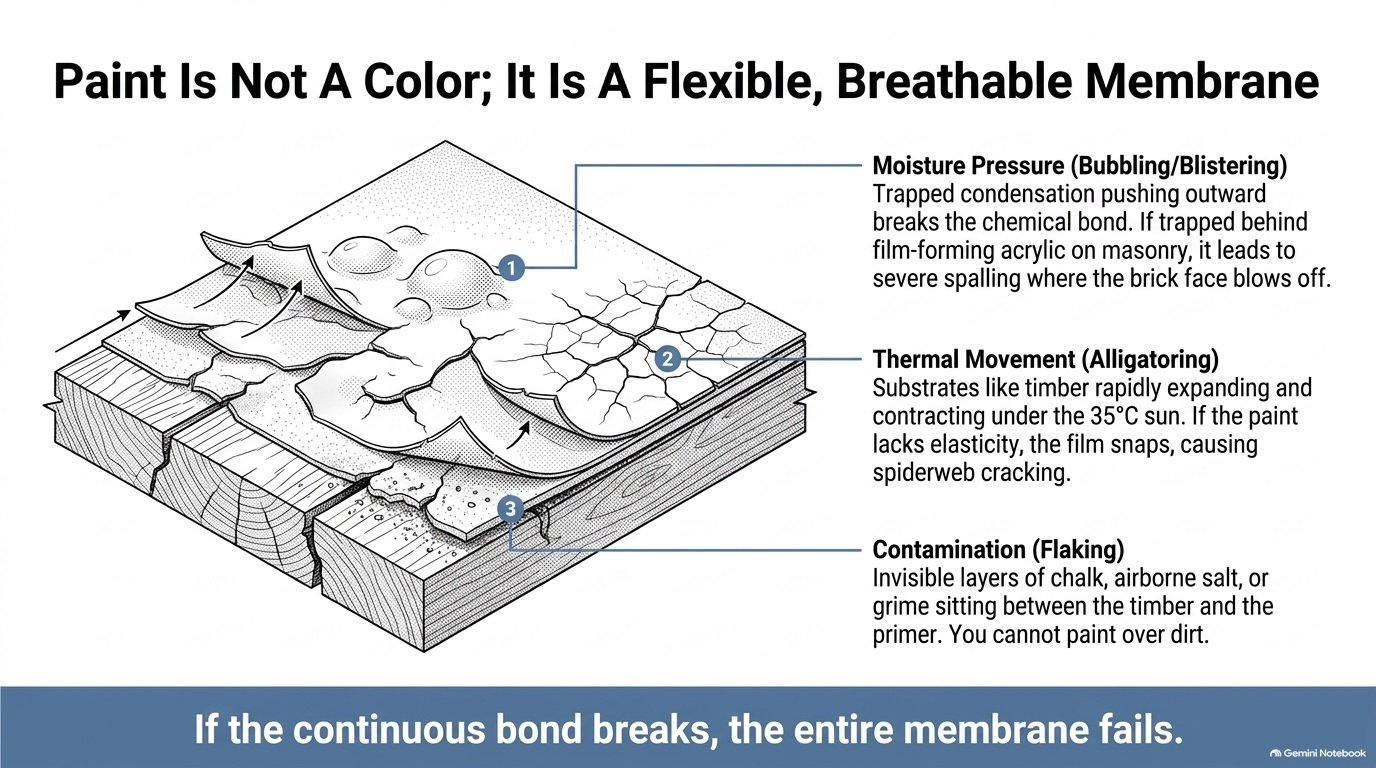
The chasm between a 10-year professional finish and a 2-year catastrophic failure is not found in the final gallon of paint. Rather, it is determined by the interplay of moisture dynamics, polymer coalescence, and the chemical bridge established long before the topcoat is applied.
In our demanding local climate, where the UV index frequently hits an extreme 12 to 13, ignoring these technical nuances is the most expensive mistake a property steward can make. Let us explore the fundamental exterior house painting mistakes in Melbourne and the technical secrets to ensuring a decade-long finish.
The 70 Percent Rule of Substrate Preparation
In the sophisticated world of technical coatings, surface preparation is the fundamental chemical bridge between the substrate and the film. You cannot simply apply a premium topcoat over a compromised surface and expect it to adhere.
Melbourne’s notoriously high UV index and rapid temperature shifts work structural cladding harder than almost any other environment. Without a meticulously cleaned, scraped, and sanded surface, dirt and mold create a microscopic barrier. This barrier prevents the paint’s synthetic resins from achieving essential mechanical "keying" into the surface.
The Preparation Metric
According to data synthesized from Solshine and Modernize Solutions, preparation accounts for an incredible 60% to 70% of a successful project’s duration.
"Surface preparation represents the single most important factor determining paint longevity. Skipping or rushing this step accounts for approximately 70% of premature paint failures."
Rushing this critical phase is the primary catalyst for premature peeling. To illustrate why proper preparation is non-negotiable for our exterior painting projects, examine the difference in outcomes below.
| Preparation Method | Mechanical Keying | Expected Longevity |
|---|---|---|
| Basic Wash & Paint | Poor (Blocked by micro-debris) | 12 - 24 Months |
| Deep Scrape, Sand & Prime | Excellent (Resins bind to raw substrate) | 10+ Years |
Capillary Action and the Wet Test for Efflorescence
Recurring white powder on brickwork and masonry is frequently dismissed as a mere cosmetic blemish. However, technically speaking, it is a glaring warning sign of active moisture ingress within your property's envelope.
Technical Term: Efflorescence
Efflorescence occurs through capillary action. Water dissolves natural salts within the brickwork and carries them to the exterior surface. When the water evaporates in the sun, the crystalline salt remains.
To determine the exact severity of the powder on your exterior walls, you must perform the "Wet Test." Identifying the type of mineral deposit dictates the entire preparation strategy.
How to Perform the Wet Test
- Step 1: Lightly spray the affected masonry area with a standard garden hose.
- Step 2: Observe the reaction. If the powder vanishes when wet but returns when dry, you have water-soluble salts.
- Step 3: If the stain remains visible while wet, you are dealing with calcium carbonate (builder's scum), requiring aggressive chemical intervention.
Crucially, Think Brick Australia—the peak body for clay masonry—mandates that you must never wash these salts away with high pressure. Pressure washing simply dissolves the salts and drives them deeper into the porous brickwork, only for them to resurface later. The superior, industry-standard method is "dry brushing." This involves vigorously scrubbing the dry salt with a stiff brush and vacuuming the residue to ensure it cannot re-enter the masonry’s pore structure.
The Shadow Strategy and Managing the 20°C Temperature Delta
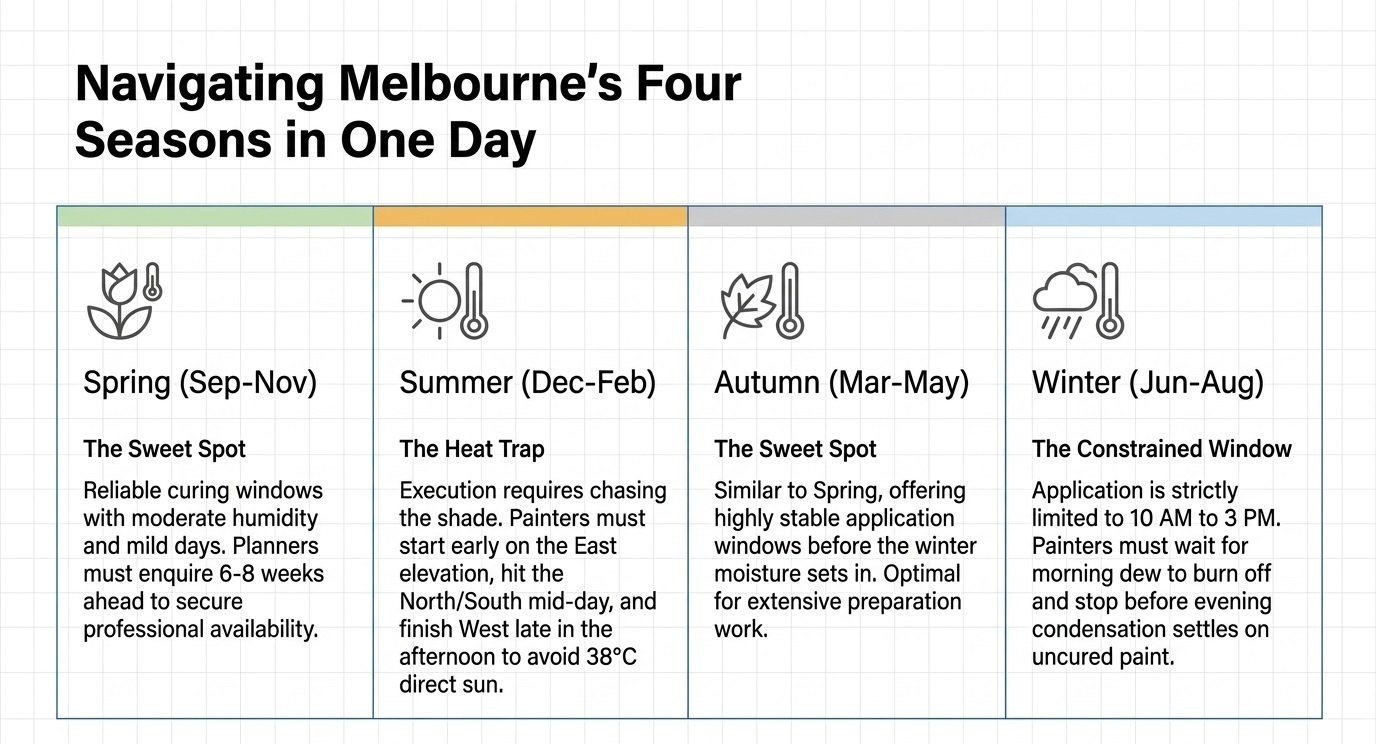
While many homeowners believe summer is the ultimate "safe" window for exterior renovation work, it presents a dangerous weather window paradox. Technical film integrity relies entirely on controlled evaporation of the paint's solvents or water base.
If paint is applied in direct sunlight, "flash-drying" occurs. The surface skins over rapidly before the lower layers have properly cured. This traps moisture underneath and prevents the proper coalescence of the resin particles, directly leading to peeling and blistering.
Critical Application Warning
Professional application strictly requires a temperature window between 10°C and 30°C. However, ambient air temperature is a highly deceptive metric.
As noted by industry peers at Northern Star Painting, a north or west-facing wall absorbing direct sun can easily be 20°C hotter than the surrounding air. To mitigate this extreme heat delta, high-end applicators employ the precise "Shadow Strategy."
Executing the Shadow Strategy
Morning
Focus strictly on the eastern elevations while they are shaded or cool.
Midday
Transition safely to the northern and southern faces to avoid the overhead peak.
Late Afternoon
Complete the western elevation only once the surface has thoroughly cooled.
The Twelve Month Interior Shortcut Trap
To the untrained eye, the 15-20% cost premium associated with premium exterior paint seems like a negotiable expense. We assure you, it is not. Using leftover interior paint for an exterior facade is a catastrophic error that guarantees rapid failure.
Formulation Differences
Interior formulations are chemically engineered for static, climate-controlled environments. They entirely lack the essential UV stabilizers and flexible resins required to survive a single brutal Melbourne winter.
Without these specialized stabilizers, the structural film integrity degrades rapidly in the sun. This leads to total failure, cracking, and peeling within just 12 to 18 months. When comparing our interior painting services to exterior works, the materials used are fundamentally different chemical compounds.
| Resin & Additive Feature | Interior Paint | Exterior Paint |
|---|---|---|
| UV Stabilizers | None | High Concentration |
| Mildewcides | Low / Minimal | Heavy Duty Additives |
| Thermal Flexibility | Rigid (Static temps) | High Elasticity |
Using interior paint on an exterior substrate is never a genuine financial saving. It is merely a deferred cost. When it fails, that cost will include the labor-intensive total removal of the failed film, representing a massive long-term financial loss for the property owner.
Why Timber Must Breathe: Movement and Priming Science
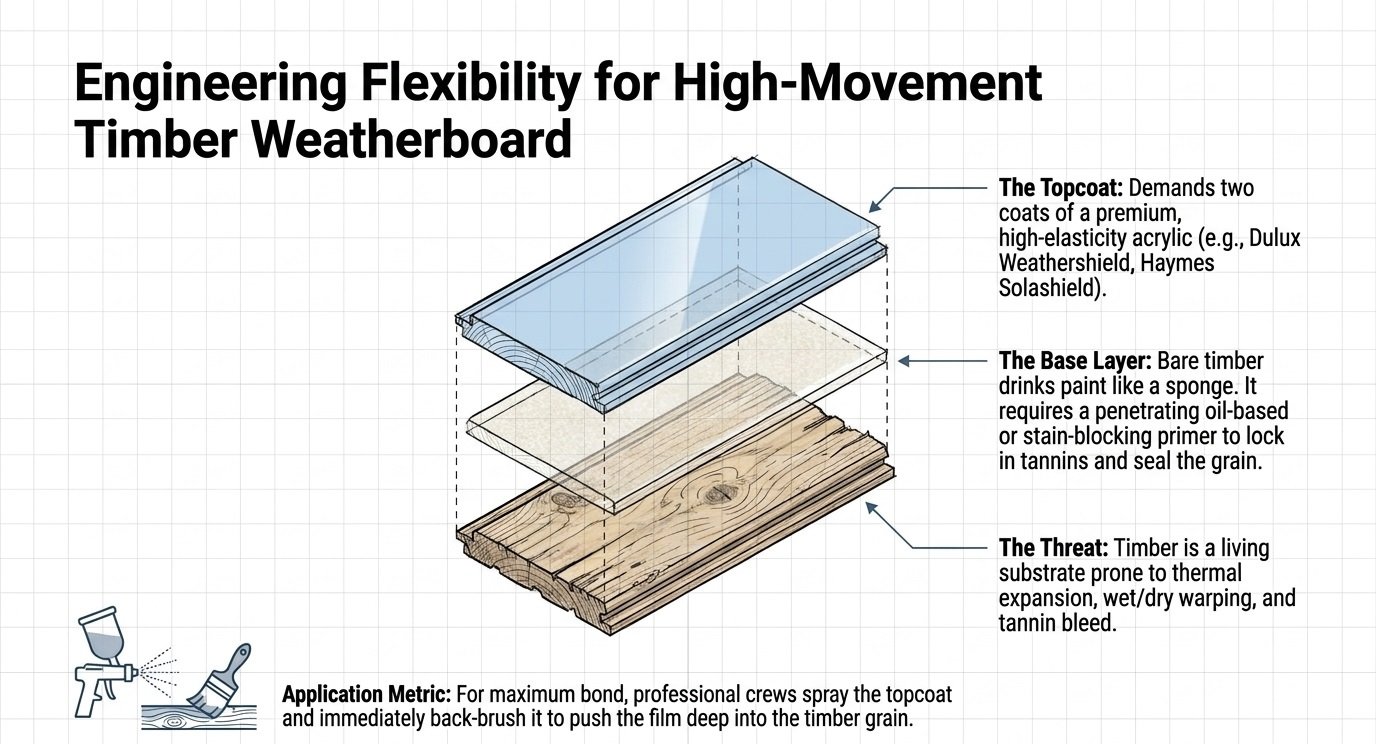
Timber is a "living" organic substrate. In Melbourne’s fluctuating humidity, traditional weatherboards and architectural trims swell and shrink constantly. To protect these volatile surfaces, the coating applied must be a flexible acrylic film capable of maintaining its elasticity over a full decade.
The Tannin Threat
We pay exceptional attention to tannin-prone timbers like rich cedar and dense hardwoods. Without a specialized, high-grade stain-blocking primer, natural oils will inevitably bleed directly through the topcoat, causing unsightly brown staining.
Furthermore, unprimed timber aggressively "drinks" the paint’s liquid binder. This phenomenon leaves the solid pigment stranded on the surface with nothing to hold it together. The result is a highly chalky, patchy, and unprotected finish that fails prematurely.
Technical Checkpoint
Priming is not a gentle suggestion or an optional up-sell. It is the necessary chemical seal that ensures the expensive topcoat actually serves its purpose as an environmental shield.
The Invisible Danger of Lead Paint Protocols
For owners of pre-1970 homes (and some built right up to 1978), property restoration carries a severe legal and health-related obligation. Managing heritage properties requires an acute awareness of historical building materials.
Toxic Dust Hazard
Traditional dry-sanding of lead-based paint creates highly toxic microscopic dust. This invisible dust can easily saturate the property’s soil, neighboring yards, and the home's interior, causing severe health complications.
Testing older surfaces is completely non-negotiable. If you suspect your home has historical coatings, you must verify its chemical composition before any abrasion occurs.
Lead Management Protocol
- Utilize a simple DIY 3M LeadCheck swab on a cross-section of the paint film.
- If the swab turns red, heavy lead concentrations are definitively present.
- Implement wet-sanding and professional environmental containment immediately.
Note: Stable lead paint is relatively safe if left entirely undisturbed. However, once that seal is broken during preparation, the management must be clinical.
Delaying Maintenance Until Structural Failure Occurs
The final, and perhaps most economically devastating mistake, is viewing exterior paint purely as decoration rather than a vital structural membrane. Durability is fundamentally a science of timing, applied chemistry, and immense patience.
Financial Investment Brackets
From a financial perspective, a professional restoration in Melbourne typically ranges from $10,000 to $18,000 for standard single-storey homes. For complex, heavily detailed heritage properties, this can scale up to $35,000. These figures accurately reflect the labor-intensive reality of the 70% preparation rule.
When your masonry shows early signs of failure, or timber begins to split, action must be taken. Under rigorous Australian building standards like AS 3740 or AS 2870, exterior moisture management is categorized as a structural necessity, not merely an aesthetic choice.
"If your paint is actively failing and flaking, the cost of waiting is no longer the simple price of a tin of paint. It rapidly becomes the exorbitant cost of structural timber replacement and deep masonry repair."
Watch: The Anatomy of a Perfect Exterior Finish
Final Thoughts on Property Stewardship
Achieving a flawless, decade-lasting finish requires more than a premium brush. It demands a rigorous understanding of substrate science, environmental temperature management, and strict chemical adherence. By avoiding these 7 exterior house painting mistakes in Melbourne, you protect not just the visual appeal of your home, but its structural integrity for years to come.
Frequently Asked Questions
Secure a Decade-Long Finish for Your Home
Don't risk structural damage with poor preparation. Trust Renova Co, Melbourne's specialists in professional exterior and commercial painting. We deliver high-quality, scientifically sound work backed by a solid satisfaction guarantee.
📍 65 Maple Crescent, Hoppers Crossing, Australia | 🕒 Mon–Sat, 8am–6pm