
The Hook: Why Your Living Room Isn't a Movie Set (and Why That Matters)
For the modern homebuyer, the search for a property doesn’t begin at the curb; it begins in the curated, high-definition dreamscape of renovation television. When discussing modern home staging and renovation, we must acknowledge that we have become a culture of "after" photos, conditioned by forty-minute episodes to expect every listing to be a move-in-ready masterpiece. This "movie set" mentality has fundamentally shifted the psychology of the real estate market, creating a unique set of challenges for both buyers and the professionals guiding them.
However, the highly anticipated "2025 Profile of Home Staging" from the National Association of REALTORS® (NAR) provides a necessary reality check. The comprehensive data suggests that while the glamour of the screen drives intense initial interest, it often crashes forcefully against the practical realities of the current housing market.
Industry Term: Cognitive Intervention
Effective staging is no longer just about arranging "pretty furniture." In today's market, it is a strategic cognitive intervention designed to manage the disappointment gap between televised fiction and physical reality. It actively rewires how a potential buyer processes spatial dimensions and property value upon entering a room.
The following analysis reveals the most impactful findings from the latest industry research, highlighting exactly how savvy sellers use staging as an essential psychological tool to navigate widespread expectation inflation. Let's explore the metrics that matter most when preparing a property for the 2026 market landscape.
The Visualization Multiplier: Helping Buyers See Their Future
As a seasoned market analyst, I view staging not merely as an aesthetic choice, but as a critical cognitive tool that significantly reduces "visual noise." A vacant room isn't just empty; it represents a high cognitive load for a buyer who must independently calculate scale, purpose, and livability. Without spatial anchors, human brains struggle to accurately estimate whether a king-sized bed or a sectional sofa will fit into an empty square box.
Staging effectively bridges this imaginative gap, seamlessly transforming an abstract architectural structure into a relatable, emotionally resonant home. It removes the friction of guesswork.
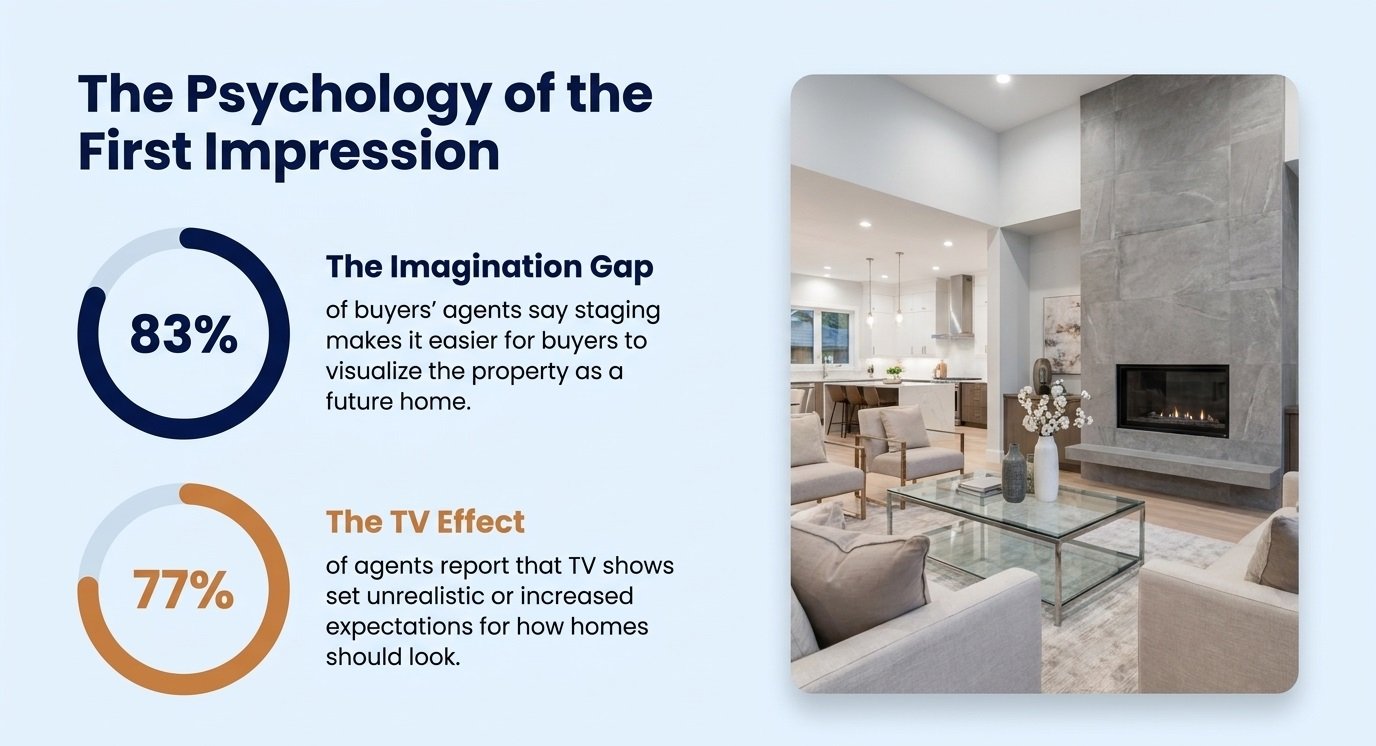
"Eighty-three percent of buyers’ agents reported that staging a home made it easier for a buyer to visualize the property as a future home."
By strategically neutralizing a space and providing intentional, carefully curated focal points, staging removes the complex mental hurdles that prevent a buyer from moving in—at least in their mind. It acts as the ultimate visualization multiplier that successfully turns a sterile "showing" into a tangible "future." When buyers don't have to strain to imagine where the TV goes or how a dining table fits, they can instead focus on the emotional connection to the property.
The "HGTV Effect": A Double-Edged Sword for Expectations
Television programming has entirely revolutionized buyer awareness, elevating the general public's understanding of design trends and architectural possibilities. But it has simultaneously fueled a pervasive and damaging trend known as "expectation inflation." Real estate professionals are increasingly finding themselves battling a fierce "disappointment gap" where the reality of the secondary market cannot possibly compete with the unlimited production budgets and time-lapse magic of modern cable TV.
Market Reality Check: 77% of agents definitively report that these home renovation shows set wildly unrealistic or vastly increased expectations for the average buyer walking into a standard listing.
The Disappointment Gap
This disconnect explains why 38% of buyers now report that the homebuying process was substantially harder than they originally expected. They aren't just looking for a functional house; they are actively looking for a pristine television set that doesn’t actually exist in the real world.
| Metric Type | The Data Point | Market Impact |
|---|---|---|
| The Expectation | The "TV-Perfection" standard: 48% of buyers believe homes should look exactly like they were staged for a camera crew. | Creates instant dissatisfaction when touring older or lived-in properties. |
| The Reality | The "58% Disappointment Gap," representing the vast majority of buyers who expressed frustration when listings failed to mirror media standards. | Forces sellers to invest in pre-market preparations just to reach baseline acceptability. |
The Room Hierarchy: Prioritizing the Living Room and Primary Suite
From a strict investment perspective, not every square foot of your property deserves a staging budget. The data suggests a harsh reality check for well-meaning sellers who spend precious time and money fluffing secondary guest rooms while inadvertently ignoring the primary living areas. Strategic budget reallocation is the smartest move a seller can make in a competitive landscape.
The Must-Stage Priority Rooms
- Living Room: The undisputed heart of the sale. Staged by 91% of sellers' agents, it is the primary area where 37% of buyers' agents say their clients form their strongest emotional attachment.
- Primary Bedroom: Staged by 83% of sellers' agents, this is the second vital pillar of a successful listing, providing a deep "sanctuary" signal that anxious buyers deeply crave.
- Kitchen: While harder to "stage" in a traditional furniture sense, 68% of agents prioritize clearing counters and neutralizing this area to help buyers visualize the functional center of the home.
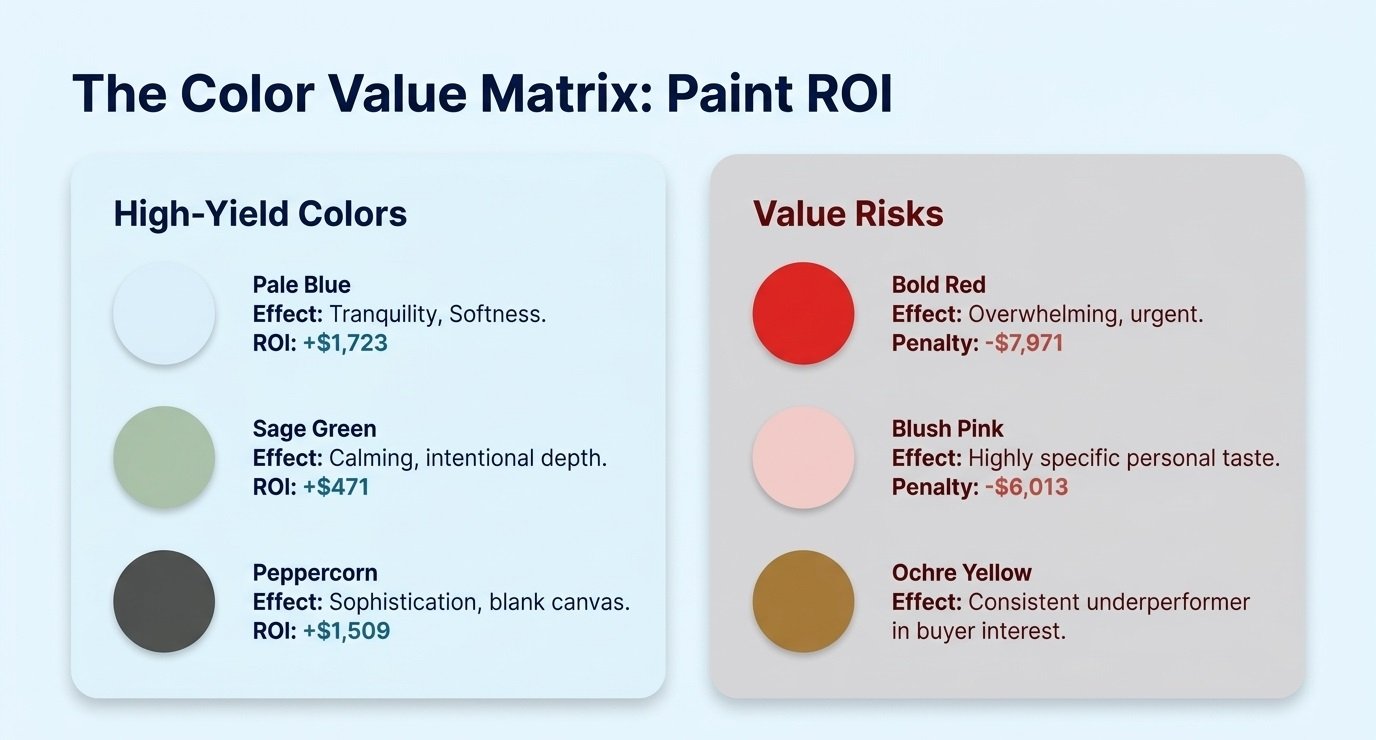
Focusing your budget on these three core areas guarantees the highest return. If your main living spaces feature outdated colors or scuffed walls, leveraging professional interior painting services is often the most cost-effective way to modernize the room before bringing in staging furniture. A crisp, neutral backdrop allows the staging to shine.
The Optional Areas: Where Not to Overspend
- Guest Bedrooms: Ranked as a high priority by only 7% of buyers' agents. Sellers are far better off moving these financial resources directly to the living room.
- Children’s Bedrooms: Along with guest rooms, these are the least common areas to be staged (22%), as they are often highly specific and too personalized to appeal to a broad, diverse buyer pool.
The 1-5% Bump: The Real ROI of Staging
While staging undoubtedly requires an upfront capital investment, the data unequivocally confirms a highly measurable and reliable return. Between 17% and 19% of agents—representing experts on both the buyer and seller sides of the negotiating table—report that professional staging successfully increases the final offer value by a margin of 1% to 5%.
The Market Velocity Impact
30%
of agents see a noticeable decrease in time on market for staged homes, ensuring sellers avoid costly carrying charges and price reductions.
For a listing sitting in the $500,000 to $749,999 price bracket—which represents the most common range for staged homes evaluated in the NAR report—the underlying math is incredibly compelling for any seller on the fence about the process.
| STAGING ROI ANALYSIS: $500k - $750k HOME BRACKET | |
|---|---|
| Median Professional Staging Cost | -$1,500 (Investment) |
| Median Agent-Led Staging Cost | -$500 (Investment) |
| Potential 1% Offer Increase | +$5,000 to +$7,500 (Return) |
| Potential 5% Offer Increase | +$25,000 to +$37,500 (Return) |
Bottom Line on ROI
Even at the highly conservative lower 1% increase, the $1,500 upfront investment pays for itself multiple times over, generating pure profit for the seller. Simultaneously, it contributes to a much-desired decrease in days on market.
The Invisible Committee: The Power of Non-Resident Family Members
One of the most fascinating and consequential trends in modern real estate transactions is the rise of the "invisible committee"—the group of off-site influencers, parents, siblings, or financial backers who hold the ultimate power of veto. While the primary buyer physically walks through the home, they are constantly mentally reporting back to a robust support network that may never actually enter the front door.
"Ninety-seven percent of buyers consulted with family members during the buying process, even though those family members would not be living in the home."
The Digital Staging Mandate
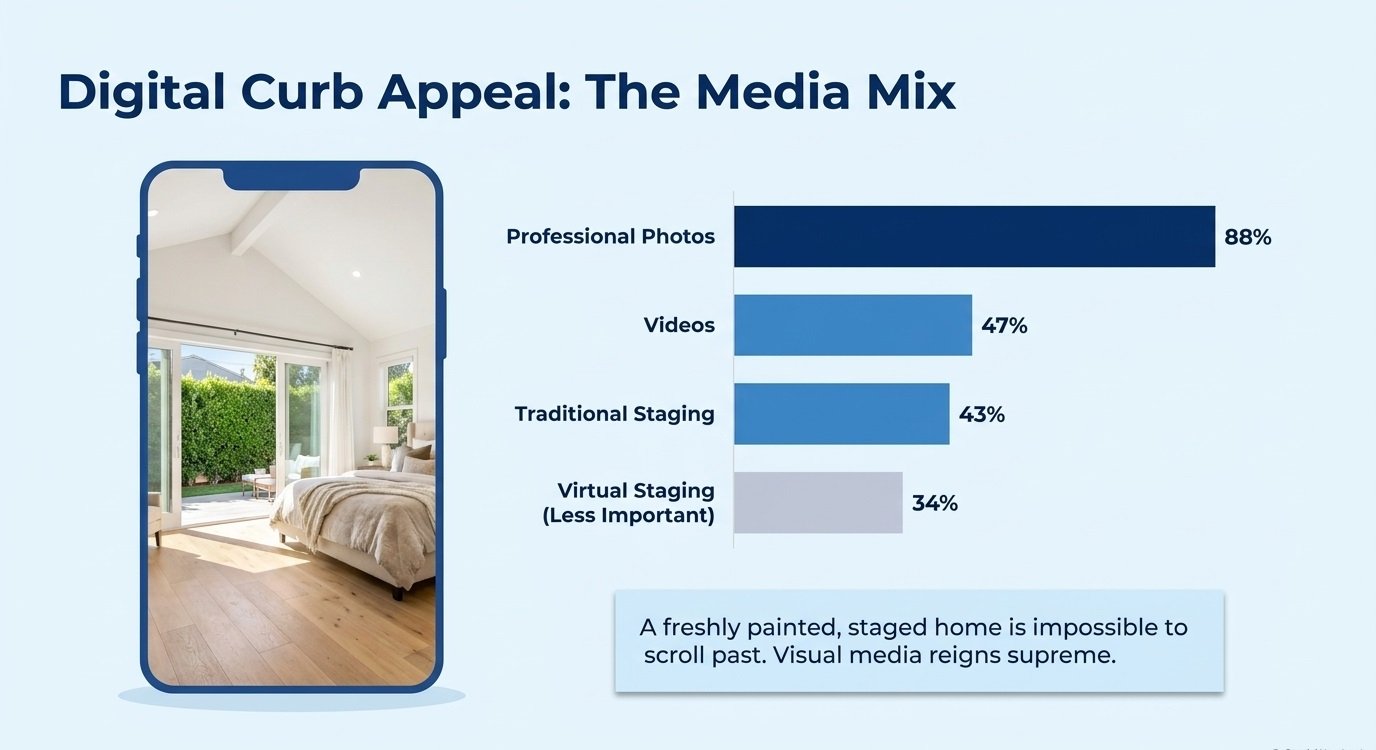
The statistical nuance here is hyper-critical: while an overwhelming 97% consult family, a median of only 23% actually bring those family members to a physical showing. This makes high-quality digital assets—specifically listing photos, which are deemed "much more important" by an incredible 73-88% of agents—the absolute primary way a seller "stages" for the people actually making the final financial decision. If your home doesn't look perfect in a digital photo, it simply never reaches the invisible committee for approval.
Maintenance as a Signal: The "Charlotte Paint" Strategy
Cosmetic staging is often most highly effective when it serves as a direct psychological proxy for overarching property health. Take the regional market dynamics of places like Charlotte, North Carolina—or similarly weather-tested environments like Melbourne, Victoria. In a climate strictly defined by humid summers and winter extremes, a home's exterior surfaces are under constant, aggressive assault from the elements.
In this demanding context, a fresh coat of paint is absolutely not just a "pretty" cosmetic upgrade; it is an incredibly vital maintenance signal to wary buyers. When 77% of agents fiercely recommend improving curb appeal before listing and 88% recommend a deep, comprehensive cleaning of the entire home, they are directly advising sellers to visibly prove the home has been "actively maintained."
"A fresh coat of paint is more than a color choice; it's a meticulous maintenance log."
In regions where paint peels, cracks, and fades faster than the national average, a crisp, flawless exterior actively tells a buyer that the seller has vigilantly stayed ahead of the climate’s inevitable wear and tear. Partnering with an authoritative company like Renovaco Group Pty Ltd for professional exterior painting ensures your property broadcasts structural integrity right from the curb. Buyers instantly equate peeling fascia boards with expensive future repairs; crisp lines equal peace of mind.
Step-by-Step Action Plan for Sellers
Navigating this expectation gap requires a systematic approach. Before investing in furniture rental, follow this proven sequential hierarchy to maximize your home's digital and physical appeal.
The Deep Clean & Repair
Before any staging occurs, 88% of agents demand a deep clean. This includes addressing deferred maintenance like dripping faucets, scuffed baseboards, and fogged window seals. It signals baseline property health.
The "Charlotte Paint" Execution
Neutralize the visual noise. Repaint the exterior to signal aggressive weather maintenance, and coat the interior priority rooms (Living, Primary, Kitchen) in soft, universally appealing neutral tones.
Targeted Strategic Staging
Bring in scaled, modern furniture exclusively for the Living Room (91% priority) and Primary Suite (83% priority). Leave secondary guest rooms and specific children's spaces neutrally empty if budget is tight.
Digital Asset Capture
Hire a top-tier architectural photographer. These images are the only way your property will pass the brutal vetting of the "invisible committee" (the 97% of families consulted off-site).
Pre-Listing Photography Checklist
- Remove 50% of items from all closets to show volume.
- Hide all personal photographs and specific religious/political items.
- Ensure all interior lights are on and feature identical color-temperature bulbs.
- Remove all pet bowls, beds, and related odors prior to shooting.
Closing: The Future of the First Impression
The initial, all-important first impression of a home has permanently moved from the physical curb directly to the glowing digital screen. With discerning modern buyers now meticulously viewing a staggering median of 20 homes virtually before aggressively narrowing their physical viewing list down to just eight, the "digital stage" has become the new, unforgiving gatekeeper. If your online presence is weak, your physical door will remain locked.
While the pervasive "HGTV effect" has undoubtedly complicated the selling process by significantly inflating consumer expectations, it has also forcibly made the entire real estate industry more sophisticated and strategic. Sellers who deeply understand that modern staging is fundamentally a psychological bridge—and who ruthlessly prioritize the specific rooms and high-end digital assets that satisfy both the physical buyer and their invisible, off-site committee—will unequivocally always maintain the competitive edge.
Key Takeaway
Stop staging to make the home look "pretty" to your own eye. Stage the property to mathematically satisfy the specific cognitive demands of the 2026 buyer. Neutralize the space, signal robust maintenance through fresh paint, target the living room and primary suite, and heavily invest in the photography that captures it all.
Frequently Asked Questions
Ready to Close the Disappointment Gap?
Don't let peeling paint or outdated colors ruin your property's first impression. At Renova Co, we specialize in the premium interior and exterior painting services that signal pristine maintenance to cautious buyers. Transform your listing into a high-value asset today.
Renovaco Group Pty Ltd
-
65 Maple Crescent,
Hoppers Crossing, VIC - Mon–Sat, 8am–6pm
- 100% Satisfaction Guarantee