
Understanding the true scope of commercial painting is essential for any facility manager.
When you upgrade an office, retail shop, or industrial warehouse, you are not just changing colors. You are fundamentally protecting your physical assets. High-quality commercial painting enhances employee safety, ensures regulatory compliance, and extends the lifespan of your property. Read on to discover six surprising insights that transform an ordinary commercial space into a strategic asset.
The Strategic Blind Spot in Facility Maintenance
In the demanding world of commercial facilities management, maintenance tasks face heavy scrutiny. Facility maintenance—specifically painting and resinous flooring—is frequently dismissed as a "necessary evil." Many managers view it as a purely aesthetic expense.
This perspective is a costly strategic blind spot. Treating surface upgrades as mere decoration creates significant "operational drag." When your physical environments deteriorate quietly, they erode overall productivity. Worker safety is compromised. Cleaning costs skyrocket over time.
Modern commercial coatings are not mere decor. They are high-performance industrial tools engineered to enhance substrate integrity. They actively improve workflow efficiency. By moving beyond the assumption that maintenance requires total shutdowns, facility strategists can win. Applying specialized industry standards transforms your physical plant into a highly strategic asset.
Pro Tip: Reframe Maintenance as Investment
Stop categorizing coatings under "cosmetic repairs." Classify them under "infrastructure preservation." This simple accounting shift helps secure appropriate budgets for long-lasting, professional-grade applications.
The 25-to-1 Thickness Rule for Resinous Systems
The disparity between consumer-grade retail products and professional-grade epoxy systems is vast. It is a matter of strict material reality. Many business owners try to save money with standard DIY kits. This approach often leads to disastrous operational failures.
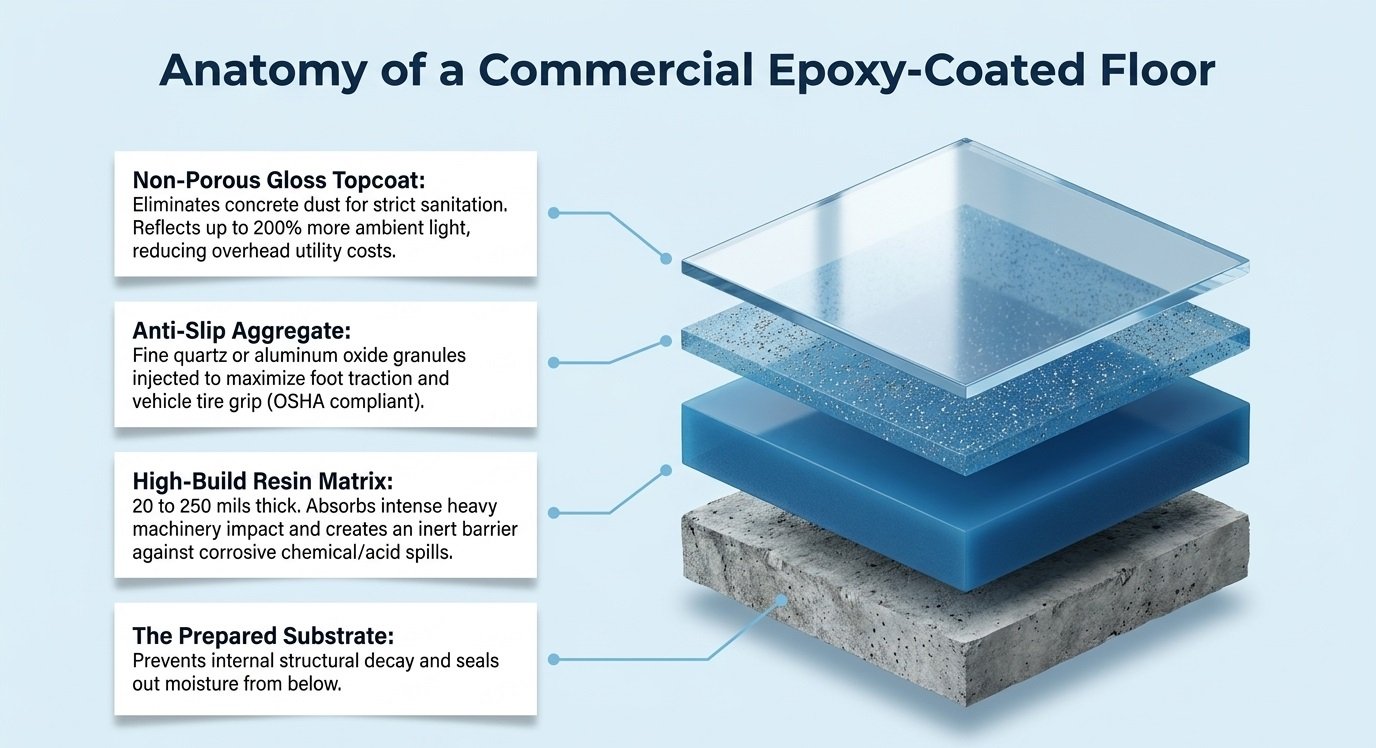
A standard DIY kit provides a "topical film" that is only 10 mils thick. In stark contrast, professional-grade resinous systems range from 20 to 250 mils. In heavy high-traffic environments, a professional installation is up to 25 times thicker than retail alternatives.
Warning: The Delamination Danger
Never apply thin, retail-grade epoxy in a commercial warehouse. Heavy machinery will quickly cause hot-tire pickup. The thin film will fracture, peel, and delaminate, costing you double in removal and replacement fees.
This incredible thickness is not just a difference in volume. It is a fundamental difference in engineering. Professional-grade material bonds chemically with the underlying concrete substrate. It creates a "unified foundation" rather than a fragile, temporary surface layer. Our epoxy flooring specialists know this structural resilience is mandatory. It is the only way to withstand the relentless daily abuse of heavy commercial machinery.
| Metric | DIY Retail Epoxy | Professional Commercial Epoxy |
|---|---|---|
| Average Thickness | ~10 mils | 20 to 250 mils (Up to 25x thicker) |
| Bonding Mechanism | Topical mechanical adhesion | Deep chemical fusion with substrate |
| Lifespan under Heavy Load | 1 to 2 years max | 10 to 20+ years |
| Impact Resistance | Low (Prone to chipping) | Extreme (Absorbs heavy machinery shocks) |
Illuminating Success Through Industrial Lighting Optimization
Smart facility managers know that utility bills consume massive operational budgets. One of the most effective ways to lower energy expenditure is surprisingly simple. You can dramatically improve Quality Control (QC) through a strategy known as Industrial Lighting Optimization.
Increase in Visibility
High-gloss commercial coatings can reflect up to 200% more ambient light than unsealed, raw concrete floors.
For vast manufacturing zones and busy warehouses, this "Mirror Effect" is revolutionary. It maximizes your current lumen efficiency without the massive capital expenditure of buying new lighting hardware. The smooth, glossy floor bounces light upwards.
By reflecting light back into the workspace, these surfaces actively reduce employee eye strain. They create a safer, far more vibrant atmosphere. Furthermore, this increased illumination is a critical component for your bottom line. It maintains accurate quality control during heavy production. Defects become highly visible. Crucial safety protocols are easily followed—all while simultaneously reducing your monthly utility loads.
The "Invisible" Renovation and Rapid Return-to-Service
The primary hurdle holding back facility managers is the intense fear of operational downtime. Closing your doors means losing revenue. However, modern coating technology has solved this dilemma entirely. We utilize a powerful technical trinity.
Industry Terminology Breakdown
- Low-VOC Formulations: Paints with vastly reduced Volatile Organic Compounds. They address indoor air quality immediately, ensuring no lingering solvent smells disrupt your occupants.
- Rapid-Curing Resins: Advanced chemical mixtures engineered for high RTS (Return-to-Service) speed. They allow surfaces to be transformed and cured overnight.
- Operational Zoning: The logistical art of phasing work into specific zones. It ensures the majority of your facility remains active while the crew leaves zero "operational footprint."
These three factors allow for massive infrastructure upgrades without ever closing your business doors. The distinction between excellent air quality and high RTS speed is vital for continuous workflow. You protect your staff's lungs while keeping production lines moving.
Mid-Point Recap: Why Commercial Upgrades Pay Off
So far, we've established that commercial painting isn't decorative—it's structural. By leveraging 250-mil thick chemical bonds, exploiting the 200% light-reflection mirror effect, and deploying rapid-cure zoning, businesses can overhaul their facilities seamlessly. This ensures zero operational downtime while radically improving safety and visibility.
Reducing Total Cost of Ownership with Smooth Surfaces
Financial officers monitor the Total Cost of Ownership (TCO) closely. There is a direct, measurable correlation between floor quality and the TCO for material-handling equipment. Neglected concrete surfaces degrade rapidly under warehouse operations.
When old concrete surfaces suffer from "dusting" or "laitance" (the continuous generation of fine powder particles), your sensitive machinery is severely compromised. That dust infiltrates expensive motors. It coats pristine inventory. Furthermore, uneven or pitted concrete causes intense vibration. Sudden jolts lead directly to the premature failure of forklift steering columns and suspension systems.
Actionable Checklist: Substrate Integrity Assessment
Inspect your facility floors today. Look for these four critical failure signs:
- Fine white powder accumulating on inventory racks (Concrete Dusting).
- Visible pitting or minor craters in high-traffic forklift aisles.
- Dull, stained areas where oil or chemicals have penetrated the surface.
- Audible clattering or excessive bouncing when machinery drives over joints.
A perfectly leveled, high-build coating acts directly as a preventative maintenance tool. By eliminating the heavy mechanical stress caused by rough surfaces, businesses significantly reduce their ongoing fleet repair overheads. Investing in top-tier substrate integrity today safely prevents the compounding costs of vehicle downtime tomorrow.
Defining Quality with the 1-Meter Standard
Defining professional workmanship is often a frustrating point of contention. Clients and contractors frequently argue over final finish expectations. However, the PDCA P1 industry standard provides a clear, unarguable "Performance Metric for Close-out."
This vital standard actively protects the facility owner from subpar, rushed work. Simultaneously, it protects the contractor from highly subjective, impossible nitpicking. It achieves this by defining a "properly painted surface" through three strict, objective criteria.
The PDCA P1 Proper Inspection Protocol
Required Distance
The finished surface must be strictly examined from exactly 39 inches (one meter) or more away. Pressing your nose to the wall is invalid.
Zero Magnification
The inspection must be completely conducted without the use of any magnification tools, magnifying glasses, or zooming lenses.
Natural Finished Lighting
The surface must be viewed directly under the finished lighting conditions of the room, from a normal, standing viewing position. Flashlights held at harsh angles are not permitted.
This standard ensures quality control remains grounded in reality. It is based solely on real-world daily usage and established industry norms. It stops inspectors from demanding unattainable or non-functional perfection that delays project sign-offs.
Mitigating Regulatory Liability: EPA RRP Protocols
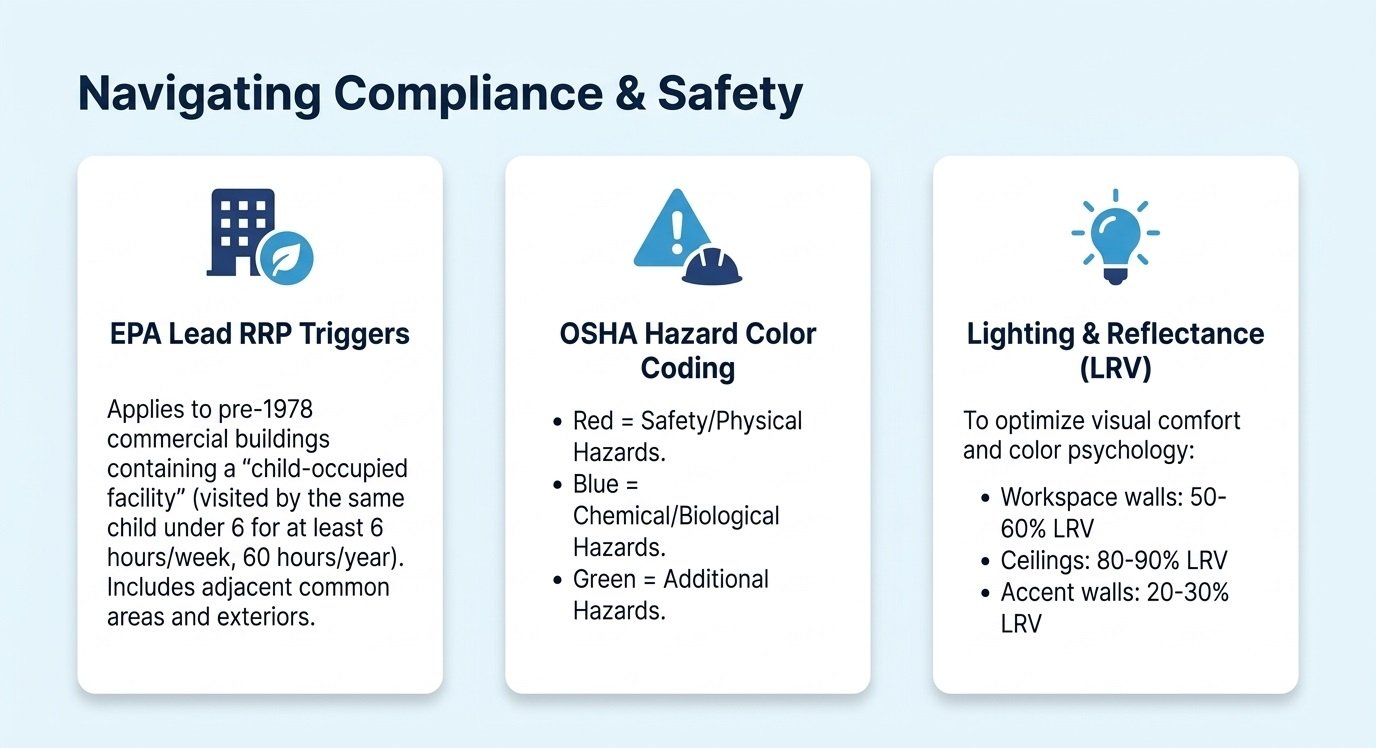
Navigating the complex regulatory landscape is absolutely essential for mitigating serious legal liability. Commercial property owners face massive fines for ignorance. While most modern commercial buildings are generally exempt from the EPA’s RRP (Lead Renovation, Repair, and Painting) Rule, crucial exceptions exist.
Critical Compliance Warning
The EPA RRP rule triggers immediately if a "child-occupied facility" exists anywhere within the commercial property. Failure to comply can result in devastating federal fines and total project shutdowns.
A commercial space is strictly classified as a child-occupied facility under specific conditions. It must have been built before 1978. It must also host regular visits by vulnerable age groups. Understanding these precise metrics is vital for property managers.
| Metric Factor | Required Threshold to Trigger Rule |
|---|---|
| Building Age | Constructed prior to 1978 |
| Child Age Requirement | Visited by the same child under six (6) years of age |
| Daily & Weekly Duration | Visits last at least 3 hours per day, occurring on at least 2 different days per week |
| Accumulated Weekly & Annual Time | Combined visits total at least 6 hours weekly and 60 hours annually |
In these specific cases, strict lead-safe protocols must be flawlessly followed. This is required to remain in compliance with federal law. Employing fully certified, deeply experienced commercial painters is non-negotiable here.
Protecting the Material Legacy of Your Facility
Ultimately, massive industrial investments require specialized preservation. From installing 250-mil thick epoxy shields to executing the logistical precision of after-hours phasing, these interventions matter. They are meticulously designed to protect your facility’s long-term material legacy.
Pro Tip: Climate Defense Strategies
In regions experiencing extreme weather shifts, structural coatings must be flexible. Extreme freeze-thaw cycles—like those seen in Colorado or rapid temperature drops in parts of Victoria—can wreak absolute havoc on standard paint. Always consult specialists for elastomeric climate solutions.
Choosing the right industrial partner is paramount to your success. You need experts who understand both the molecular chemistry of modern paints and the physical realities of harsh climates. Whether tackling complex exteriors or refined interior painting services, precision is everything.
Final Project Recap
Commercial facility maintenance demands rigorous standards. By understanding TCO, strictly applying the PDCA P1 standard for final inspections, and strictly navigating EPA compliance, facility managers eliminate massive risks. Partnering with elite experts transforms stressful renovations into highly profitable, invisible asset upgrades.
Transform Your Commercial Space Today
Renovaco Group Pty Ltd, directed by industry expert Matthew Jahanbakhsh, specializes in highly technical commercial painting and epoxy flooring. Backed by a satisfaction guarantee, our fully licensed Melbourne team uses premium materials to meet rigorous industry standards.
Mon–Sat, 8am–6pm | Serving Melbourne & Surrounding Regions
Frequently Asked Questions
The 25-to-1 rule highlights the difference between DIY epoxy and professional commercial flooring. DIY kits provide a topical film only about 10 mils thick. Professional-grade resinous systems range from 20 to 250 mils. In high-traffic environments, a professional installation is up to 25 times thicker, bonding chemically for structural resilience.
The PDCA P1 industry standard objectively defines a properly painted surface to protect both owners and contractors. Inspections must strictly occur from 39 inches (one meter) away. Furthermore, you cannot use any magnification, and you must view the wall under the finished lighting conditions of the room.
A space triggers the EPA RRP rule if a "child-occupied facility" exists within the property. This applies to buildings built before 1978 that are visited by the same child under six years of age. The visits must total at least two days a week, lasting at least three hours a day, totaling at least six hours weekly and 60 hours annually.