
Comprehensive Analysis of Interior, Exterior, and Commercial Painting Cost Estimation in Melbourne
Mastering the underlying mathematical models, labor productivity rates, and regulatory compliance obligations that dictate trade pricing in Victoria.
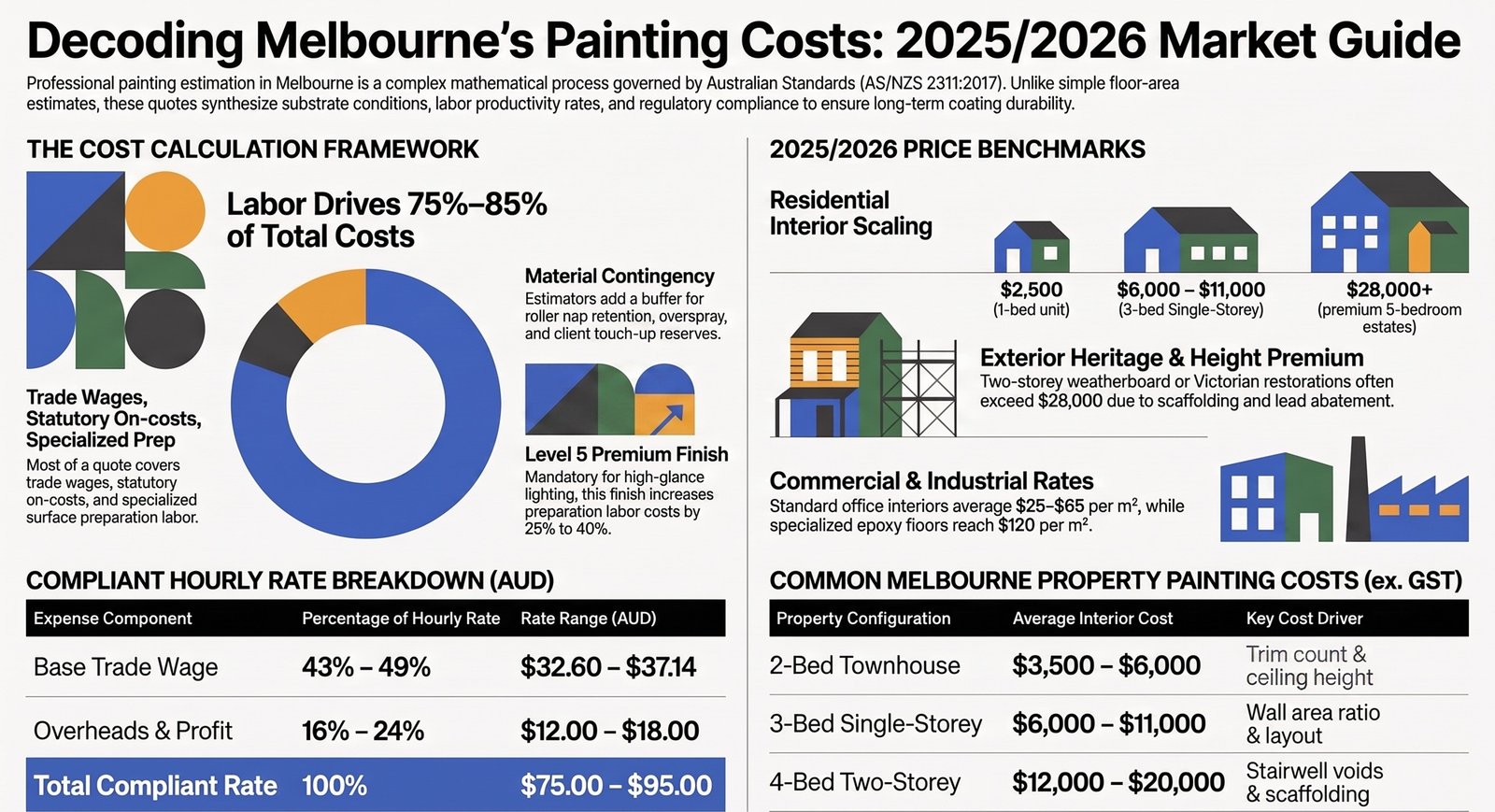
Understanding Melbourne painting costs goes far beyond looking at simple floor plans. Professional quotes rely on a multi-variable quantity-surveying framework.
Estimators must look closely at substrate conditions, Australian Standards compliance, and access equipment. They also factor in labor laws and environmental exposure. Melbourne's property landscape is incredibly diverse. From heritage Victorian weatherboards in the inner suburbs to sprawling industrial warehouses, every project demands specific cost-estimating methodologies.
Core Cost Calculation Methodologies and Mathematical Frameworks
Professional painters and cost estimators use systematic quantitative approaches. They convert architectural drawings or physical site measurements into fixed-price tenders. These methods transition from simple geometric dimensional analysis to complex cost-build-up models. They account for direct labor, material consumables, equipment overhead, and statutory compliance.
Geometric Surface Area Derivation
Technical Definition: Net Paintable Surface Area
The primary baseline for any painting quote is the net paintable surface area, measured in square metres (m²). Quantity surveyors calculate total vertical and horizontal surface areas, explicitly deducting non-painted architectural openings like doors and windows.
For a standard rectangular room, the gross wall area is derived from the room's perimeter multiplied by its wall height. In these calculations, specific deductions are critical. A standard single internal door subtracts around 1.6m² per side from the paintable area. Average window openings deduct significant surface space as well.
Ceiling surface area is calculated directly from the horizontal floor dimensions. Linear elements—such as skirting boards, architraves, picture rails, and fascias—are measured in linear metres (m). These are then converted into equivalent area metrics or priced using standard linear unit rates.
Material Volume and Coverage Calculations
The volume of liquid paint required (in litres) depends on the net surface area and specified dry film thickness (DFT). It also relies heavily on the theoretical spreading rate of the paint product and the total number of coats required.
Industry Standard: Contingency Factor
A mandatory material contingency factor of 10% to 15% is added to raw volume calculations. This accounts for roller nap retention, overspray loss during airless spraying, cutting-in wastage, and essential client touch-up reserves.
Theoretical spreading rates vary drastically based on formulation and substrate:
| Paint Category & Formulation | Typical Spreading Rate | Substrate Conditions |
|---|---|---|
| Standard Interior Acrylic Topcoats (e.g., Dulux Wash & Wear) | approx. 16m² per litre | Smooth, previously painted surfaces. |
| Acrylic Sealer Undercoats (ASU) & Plasterboard Primers | 10m² to 12m² per litre | Raw plasterboard due to heavy paper absorption. |
| Exterior Masonry & Weatherboard Coatings | 14m² to 16m² (Smooth) / 6m² to 8m² (Textured) | Smooth timber vs. heavily textured cement render or weathered masonry. |
Labour Productivity Rates and Cost Build-Up
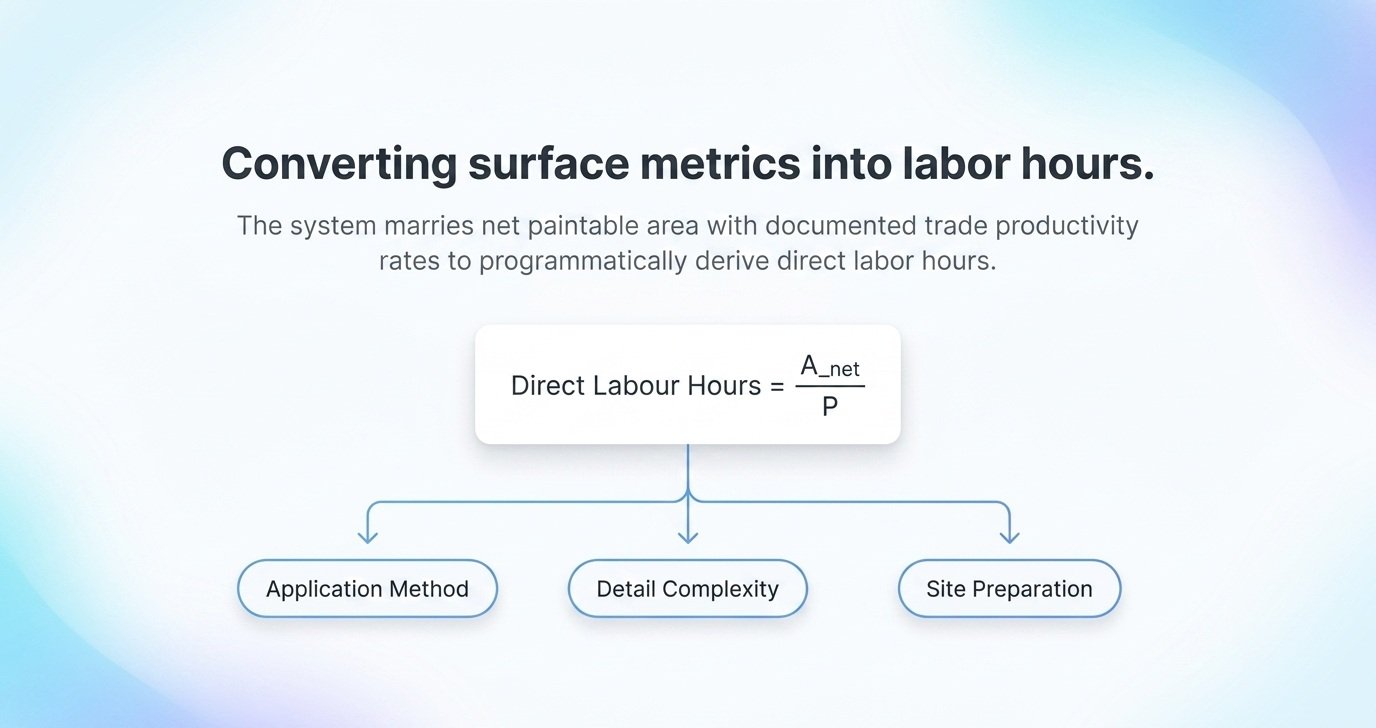
"Labour constitutes 75% to 85% of the total direct cost of a painting contract in Victoria. Estimators must convert total surface area metrics into direct labour hours using strict trade productivity rates."
Application productivity varies dramatically based on your chosen application method, detail complexity, and site preparation needs. You cannot price a spray job the same way you price detailed brushwork.
Productivity Rates by Application Method
- High-volume airless spraying: Achieves productivity rates between 40m² and 60m² per hour per coat on open ceilings or tilt-slab walls.
- Manual roller application: Averages 12m² to 15m² per hour per coat on pre-painted interior broadwalls. Drops to 8m² on bare wood or raw plaster.
- Precision brushwork: Cutting-in on architraves, door frames, and window sashes yields significantly lower productivity, averaging 4m² to 6m² per hour.
Sector-Specific Pricing Benchmarks in Melbourne (2025/2026)
Painting rates in Melbourne fluctuate heavily. It depends on whether the scope falls under residential interior repainting, residential exterior restoration, or commercial building contracts. The figures below reflect current Victorian market benchmarks derived from trade costing guides.
Residential Interior Painting Rates
Residential interior pricing is typically evaluated on a square metre of wall surface basis, a floor area baseline, or a highly itemized component schedule. When seeking our interior painting services, these base costs apply.
| Scope / Element | Unit of Measurement | Market Rate (AUD) | Key Inclusions & Conditions |
|---|---|---|---|
| Walls Only (Standard Repaint) | Per m² of wall area | $20.00 – $35.00 | 2 coats low-sheen acrylic, minor hole filling and scuff sanding. |
| Complete Package (Walls, Ceilings & Trims) | Per m² of wall area | $28.00 – $45.00 | Wall broadwall, ceiling flat acrylic, architraves/skirting enamel. |
| Ceilings Only (Standard Flat) | Per m² of ceiling area | $10.00 – $30.00 | 2 coats flat white ceiling paint, spot patching. |
| New Plasterboard (3-Coat System) | Per m² of surface area | $15.00 – $18.00 | 1 sealer undercoat + 2 topcoats as per AS/NZS 2311. |
| Flush Panel Interior Doors | Per door (both sides) | $80.00 – $120.00 | Sanding, priming, 2 coats waterborne or oil trim enamel. |
| Detailed Panel / French Doors | Per door (both sides) | $120.00 – $180.00 | Multi-panel detail handwork, sanding, 2 coats enamel. |
| Door Frames & Architraves | Per door frame | $40.00 – $120.00 | Preparation, gap filling, 2 coats trim enamel. |
| Timber Skirting Boards | Per linear metre (m) | $8.00 – $12.00 | Top-edge caulking, sanding, 2 coats trim enamel. |
| Property Configuration | Average Interior Cost Range (ex. GST) | Primary Cost Drivers |
|---|---|---|
| 1-Bedroom Apartment / Unit | $2,500 – $4,500 | Protection of compact areas, parking and lift access constraints. |
| 2-Bedroom Unit / Townhouse | $3,500 – $6,000 | Hallway cutting-in density, window trim count, ceiling height. |
| 3-Bedroom Single-Storey House | $6,000 – $11,000 | Standard room layout, full trim package, wall area ratio. |
| 4-Bedroom Two-Storey House | $12,000 – $20,000 | High stairwell voids, scaffold/ladder setup, increased door count. |
| 5-Bedroom Premium Estate | $15,000 – $28,000+ | Detailed moldings, multi-colour schemes, high-end wood finishes. |
Residential Exterior Painting Rates
Exterior residential painting in Melbourne carries higher rate variance due to weather exposure, height access costs, and substrate degradation. Quality exterior painting prevents structural moisture damage.
| Substrate / Property Type | Metric Scope | Cost (AUD) | Key Operational Factors |
|---|---|---|---|
| Single-Storey Weatherboard | Full Exterior Repaint | $10,000 – $18,000 | Scraping, edge feathering, seam caulking, priming all boards. |
| Two-Storey Weatherboard | Full Exterior Repaint | $14,000 – $28,000+ | Mandatory fixed scaffolding, extensive prep, high weather exposure. |
| Rendered / Cement Sheet Home | Full Exterior Repaint | $8,000 – $15,000 | Flexible masonry paint, crack repair, sealer undercoat. |
| Heritage Victorian / Edwardian | Complete Restoration | $14,000 – $28,000+ | Ornamental detail work, lead paint containment, multi-tone schemes. |
Commercial and Industrial Painting Rates
Commercial contracts operate under specialized rate structures. These are governed strictly by site accessibility, compliance obligations, and operational timelines. We manage large-scale commercial painting projects by standardizing these rates.
| Commercial Building Class | Rate per m² | Operational Constraints & Inclusions |
|---|---|---|
| Commercial Office Interiors | $25.00 – $65.00 | Low-VOC coatings, protection of office fitouts, tight schedules. |
| Warehouses & Logistics Hubs | $20.00 – $40.00 | High-volume airless spraying, tilt-slab priming, line marking. |
| Multi-Storey / Strata Exteriors | $35.00 – $120.00+ | Perimeter scaffolding, swing stages, elastomeric coatings. |
Mid-Article Summary: Sector Pricing
Residential quotes lean heavily on architectural complexity and footprint size, ranging from $2,500 for a 1-bedroom unit to over $28,000 for a large heritage exterior. Commercial quotes, conversely, rely entirely on rapid per-square-metre scale and access machinery costs.
Key Parameters and Price Determinants in the Melbourne Market
A precise painting quote is synthesized by evaluating technical standards, substrate conditions, height access requirements, labor laws, and chemical product specifications. A missed variable here can destroy a project's profitability or quality.
Technical Standards and Plasterboard Finishing Systems
Mandatory Benchmark: AS/NZS 2311:2017
This standard specifies that newly installed plasterboard must receive a minimum three-coat system. This consists of one coat of acrylic sealer undercoat (ASU) followed by two topcoats to achieve a minimum dry film thickness of 75 microns. Omitting the sealer undercoat causes uneven paint absorption, leaving plasterboard joints visible beneath the final topcoat.
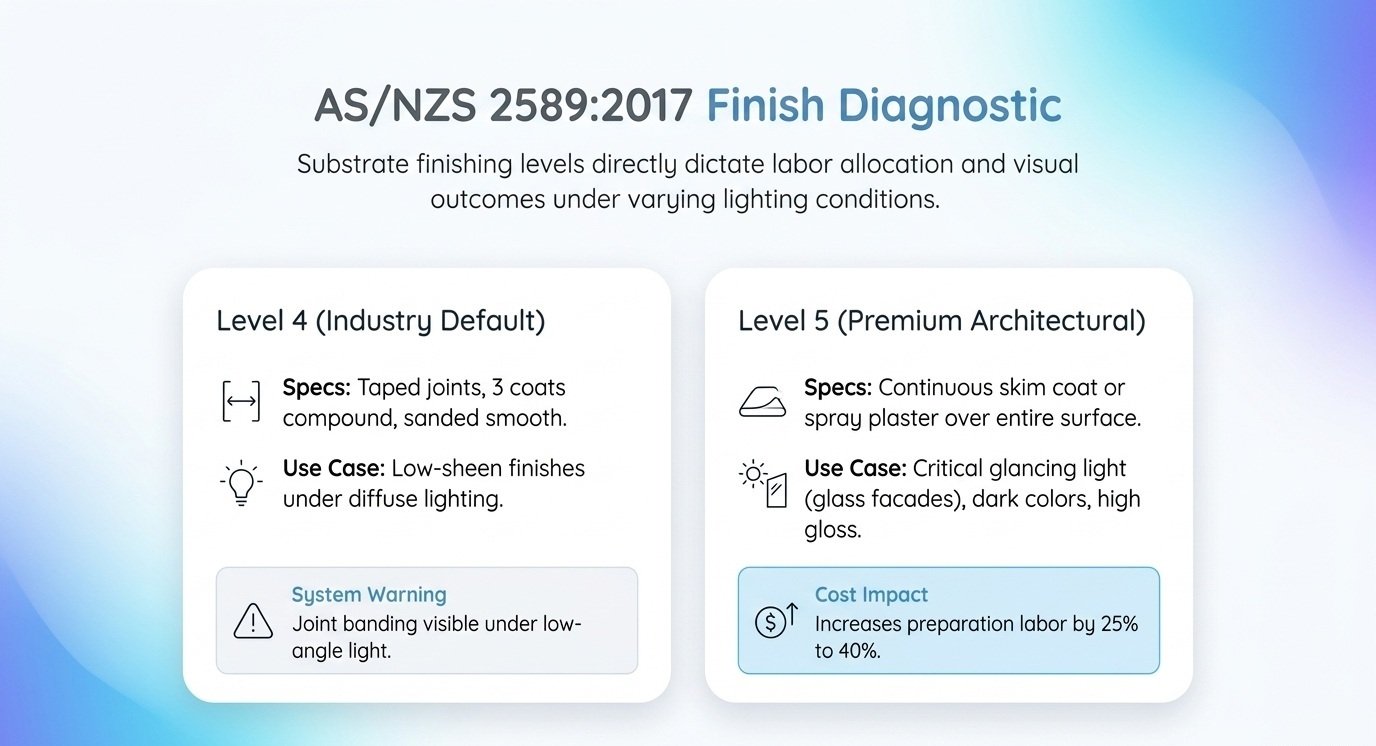
In conjunction with painting standards, AS/NZS 2589:2017 dictates substrate finishing levels prior to paint application:
- Level 4 Finish (Standard Default): Plasterboard joints are taped, finished with three coats of joint compound, and sanded smooth. Designed for low-sheen or flat paints under diffuse lighting.
- Level 5 Finish (Premium Architectural): Mandatory where critical lighting conditions occur (floor-to-ceiling glass) or where dark colours are used. Requires a continuous skim coat of joint compound over the entire wall surface. Specifying a Level 5 finish increases preparation labor costs by 25% to 40%.
Substrate Condition and Surface Preparation Dynamics
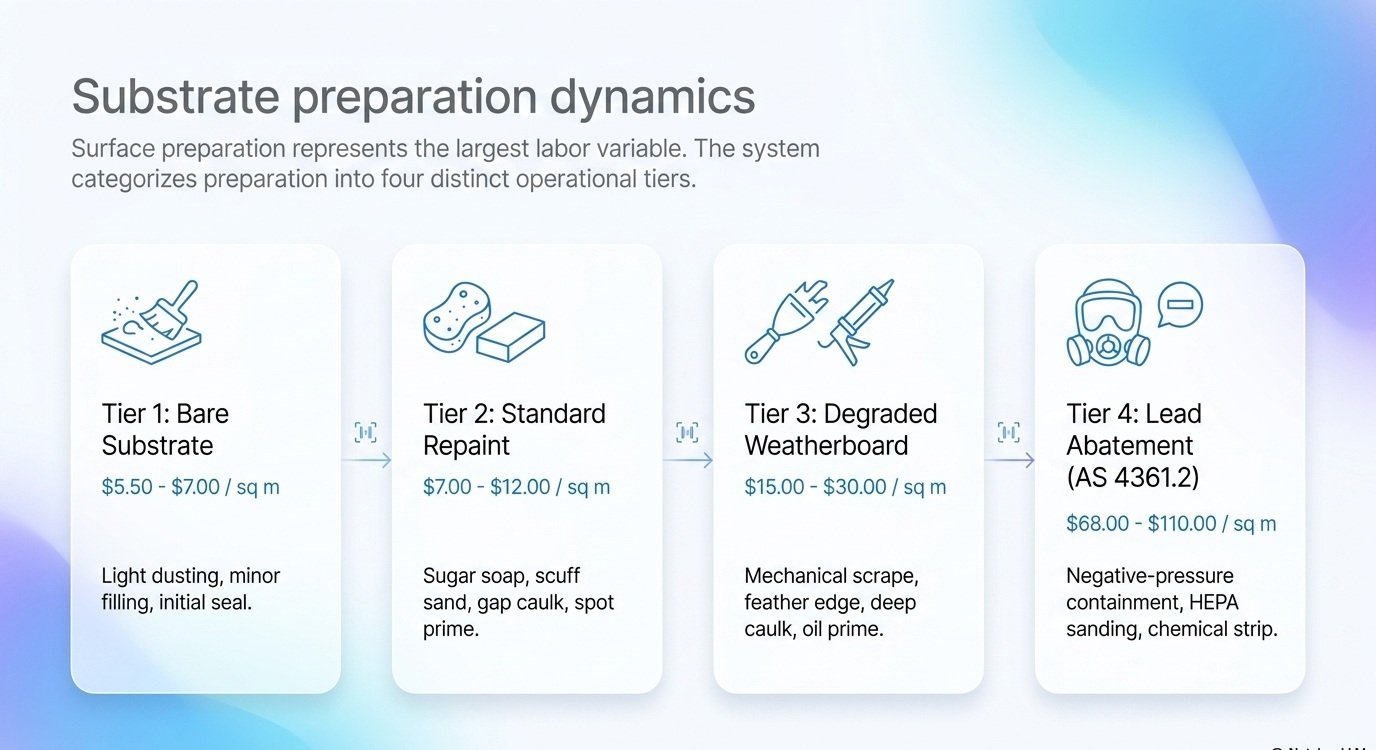
Surface preparation represents the largest variable in trade labour allocation. Cost estimators categorize preparation scopes into distinct operational tiers:
| Surface Preparation Tier | Cost (m²) | Required Operational Scope |
|---|---|---|
| New Build / Bare Substrate | $5.50 – $7.00 | Light dusting, minor nail-hole filling, initial sealer priming. |
| Standard Repaint (Sound) | $7.00 – $12.00 | Sugar soap wash, scuff sanding, acrylic gap caulking, spot priming. |
| Degraded Weatherboard Prep | $15.00 – $30.00+ | Mechanical scraping, edge feathering, deep caulking, oil priming. |
Warning: Lead Paint Abatement (AS 4361.2)
Inner-city Melbourne suburbs containing pre-1970s dwellings frequently present lead-based paint hazards. Contractors must establish sealed negative-pressure containment zones, utilize HEPA-filtered sanding gear, and apply chemical strippers. Lead abatement adds a massive $68.00 to $110.00 per square metre to preparation budgets.
Access, Safety, and Height Equipment Overhead
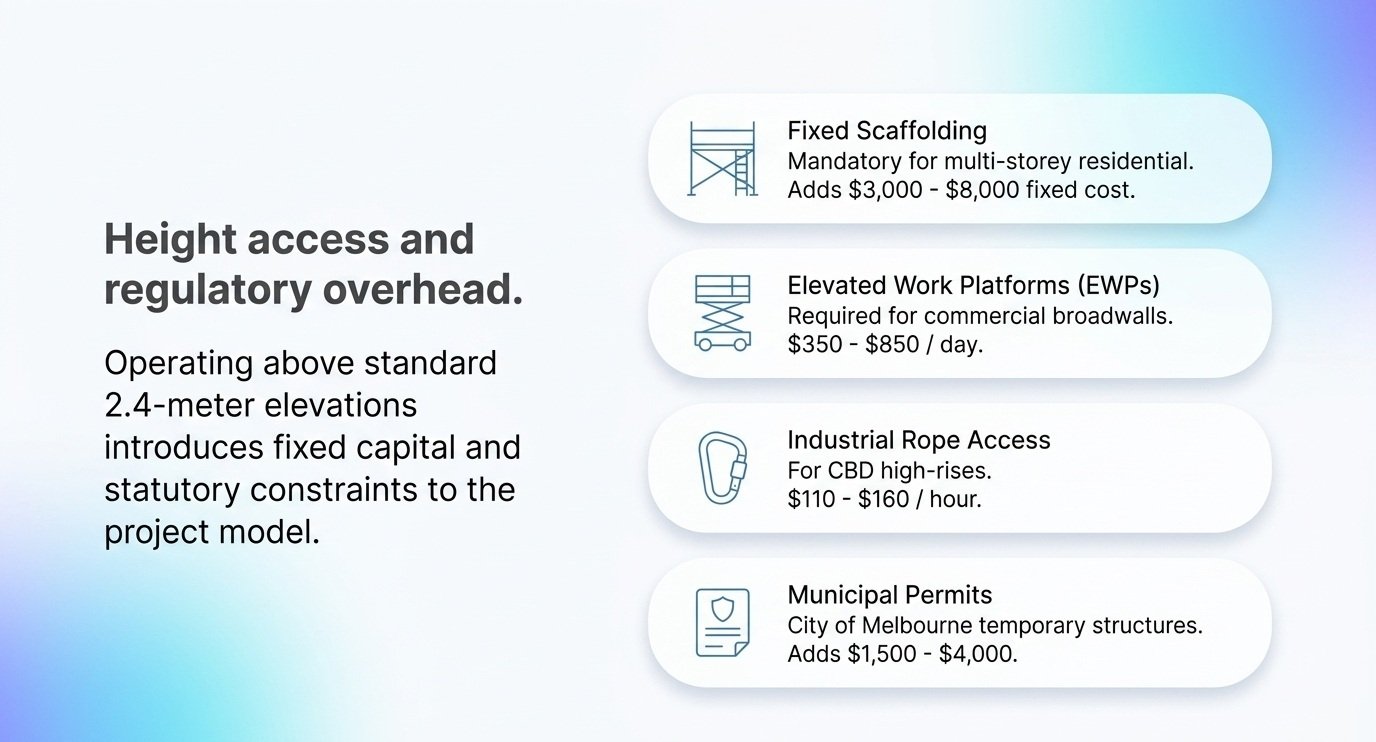
Working above standard stepladder height (2.4 metres) introduces severe equipment and regulatory overheads:
- Fixed Perimeter Scaffolding: Mandatory for multi-storey residential exterior repaints. Scaffold erection and hire add a fixed add-on of $3,000 to $8,000 for a standard two-storey dwelling.
- Elevated Work Platforms (EWPs): Scissor and boom lifts require daily hire rates ranging from $350 to $850 per machine.
- Abseiling / Industrial Rope Access: Used on high-rise CBD structures. Rope access painters command rates between $110 and $160 per hour.
City of Melbourne Municipal Permits
Placing scaffolding or EWPs on public footpaths requires a Temporary Protective Structure Permit from local councils. Permit fees, parking bay reservations, and accredited traffic control personnel add $1,500 to $4,000 to inner-metropolitan project tenders.
Labour Laws, Award Rates, and Charge-Out Economics
The Base Charge-Out Economics
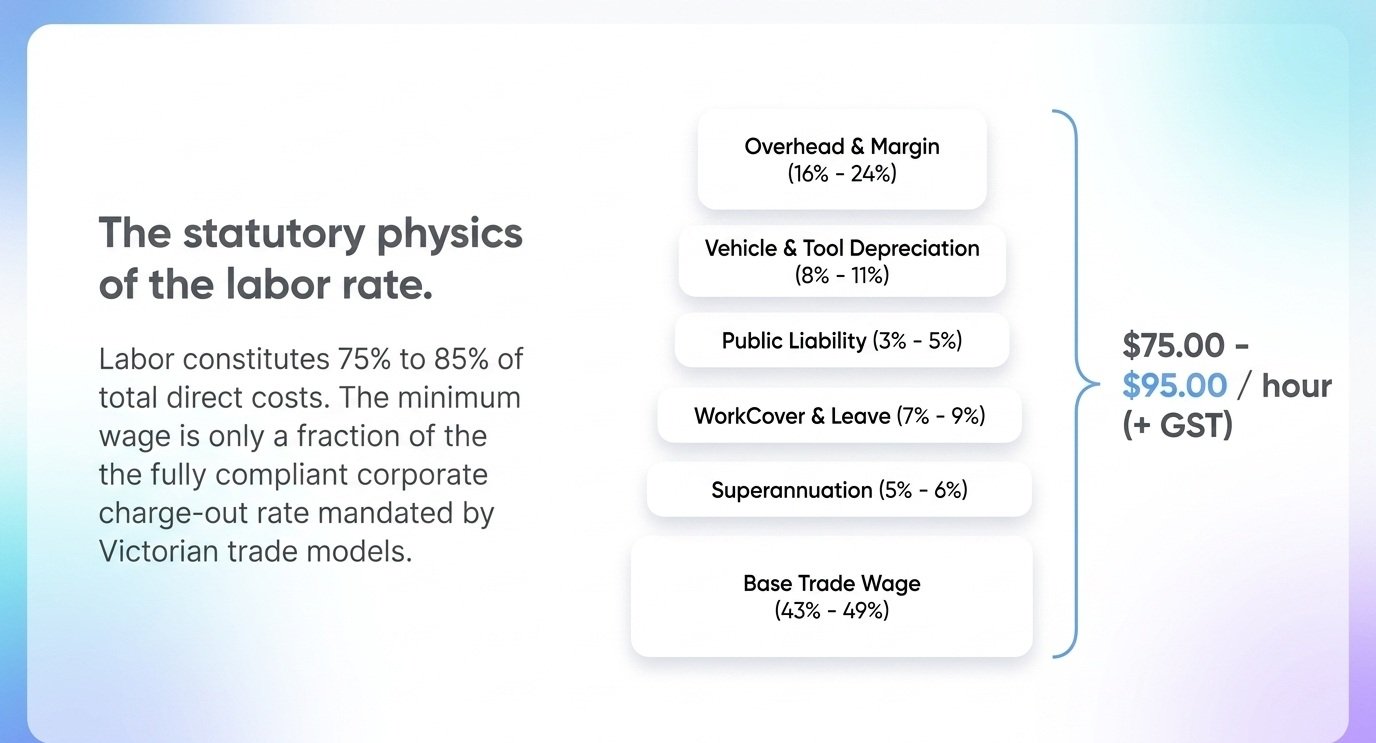
The minimum casual award rate for a qualified tradesperson painter in Victoria is approximately $37.14 per hour. However, licensed, fully insured painting companies charge out at $75.00 to $95.00 per hour + GST. In commercial settings requiring shift work or after-hours execution, penalty rates raise costs to $100.00 to $140.00 per hour.
The Master Painters Association of Victoria (MPAV) cost model illustrates how base wages build up into a compliant charge-out rate:
- Base Trade Wage: 43% – 49% of total
- Superannuation & Leave: 12% – 15% combined
- Public Liability & WorkCover: 10% – 14% combined
- Corporate Overhead & Profit: 16% – 24%
Practical Worked Calculation Examples
The following detailed cost build-ups demonstrate how quantity surveying formulas, labor productivity rates, and unit costs are applied to standard Melbourne projects.
Example 1: Full Interior Repaint of a 3-Bedroom Melbourne Residence
Project Breakdown & Timeline
Scope and Scale
Single-storey house (3 beds, living, kitchen, bath). Sound previously painted plasterboard requiring minor patching. Specs: 2 coats Dulux Wash & Wear to walls, 2 coats Aquanamel to trims.
Material Quantification
Wall paint requires approx. two 15L drums at $225. Ceiling requires one 15L drum at $145. Trim enamel requires 10L at $240. Sundries allowance is $180. Total Direct Material: $1,015.
Direct Labour Allocation
Prep, washing, masking: 12 hours. Patching/caulking: 16 hours. Ceiling/Wall rolling: 55 hours. Trim enameling: 28 hours. Cleanup: 8 hours. Total Labour: 119 hours at $75/hr = $8,925.
Final Client Investment (Example 1)
Labour ($8,925) + Materials ($1,015) + 5% Contingency ($497) = $10,437 (ex. GST). With GST added, the total investment is $11,480. This perfectly matches real-world market data for a premium 3-bedroom interior repaint.
Example 2: Commercial Warehouse Interior Broadwall Spraying
Scope & Logistics
Dandenong warehouse. High-access tilt-slab walls. Sealer + 2 topcoats. Requires 2 electric scissor lifts ($1,500). Paint total bulk cost: $4,800.
Labour Execution (Airless Spray)
Degreasing: 24h. Masking: 16h. Airless spraying (high efficiency): 120h. Demobilization: 12h. Total Labour: 172h at $85/hr = $14,620.
Commercial Tender Summary
Subtotal (Materials + Lift + Labour) = $20,920. Add 18% Commercial Margin ($3,765). Total Tender = $24,685 (ex. GST).
Industry Context Video Insight
Visualizing the reality of staging, preparation, and professional labor pricing.
Synthesis and Strategic Cost-Optimization Principles
Understanding how painting costs are calculated enables property managers and residential clients to evaluate trade bids accurately. You can spot red flags and eliminate scope ambiguities instantly.
Strategic Advice: Enforce Standardized Specifications
Tenders lacking precise coating specs create pricing distortion. Always mandate compliance with AS/NZS 2311:2017. State whether your plasterboard requires a Level 4 or Level 5 finish. Specifying paint volume solids ensures all contractors price identical standards.
You must prioritize total lifecycle costing over the upfront price. A bid sitting 30% below prevailing market averages frequently indicates reduced surface preparation. It may mean the contractor is thinning the paint or omitting mandatory sealer undercoats.
Premium paints over correctly prepared substrates yield a service life of 10 to 12 years. Under-prepared surfaces coated with low-grade paint often fail within 2 to 4 years due to peeling, chalking, and blistering. Furthermore, always unbundle access and statutory fees from core labor to ensure total transparency.
Frequently Asked Questions
Get a Precise, Professional Quote for Your Property
At Renova Co, we use these strict industry standards to ensure every quote is accurate, transparent, and fair. Specializing in high-quality interior, exterior, and commercial painting across Melbourne and Victoria. We deliver precision with a satisfaction guarantee.